
Accurate reporting from Ukraine depends on more than access—it requires trusted local relationships, operational knowledge, and the ability to connect international journalists with the people shaping events on the ground.
At Trident Group Ukraine, we support foreign media by facilitating access to key Ukrainian stakeholders, providing local expertise, and helping reporters safely navigate a complex operational environment. Our permanent presence in Kyiv and long-established professional networks enable journalists to tell important stories with greater depth, context, and accuracy.
We are proud to have supported Die Welt Foreign Affairs Editor Florian Sädler in the preparation of his article, “Today, We’re Down to 40 Seconds”: How Artem’s System Is Saving Lives, which offers readers a compelling look at Ukraine’s air alert system and the people working every day to protect civilian lives.
Reliable journalism depends on reliable local partners. By helping international media access credible sources and firsthand perspectives, we contribute to a better understanding of Russia’s illegal war against Ukraine and the realities faced by millions of Ukrainians every day.
We are deeply grateful to the international media for their unwavering commitment to covering Ukraine despite the challenges and risks, ensuring that the world continues to witness the human impact of Russia’s aggression. Our special appreciation goes to Florian Sädler for his thoughtful, professional, and deeply human reporting, which helps bring the experiences of Ukrainians to audiences around the world.
“Today, we’re down to 40 seconds”: How Artem’s system is saving lives
By Florian Sädler
Editor, Foreign Affairs
These days, there is a McDonald’s restaurant in Kyiv that has achieved something of a cult status. It stands in a neighborhood repeatedly struck by Russian missile attacks, and the restaurant itself has been hit several times. On one occasion, its windows were blown out; on another, the iconic yellow McDonald’s sign melted in the flames. Yet each time, the restaurant reopened shortly afterward. Today, customers can eat their burgers while looking out at the charred remains of ruined buildings across the street.
The story illustrates just how impossible it has become to ignore the scars of war, even in Ukraine’s capital. For a time, it was almost possible to forget that Kyiv belonged to a country at war. But as Ukraine’s stockpile of Patriot interceptor missiles has dwindled, Russia has ruthlessly exploited the resulting vulnerability. Recently, Kyiv has endured three major attacks within the span of a single week, many of them involving ballistic missiles. Dozens of people were killed and many more wounded.
According to data compiled by the Konrad Adenauer Foundation, the number of air attacks against civilian or strategic targets recorded since the start of Russia’s full-scale invasion surpassed the 100,000 mark in May. In June, at least 293 civilians were killed across Ukraine, making it the deadliest month for civilians since April 2022. That the death toll is not significantly higher is due in no small part to a sophisticated warning system that alerts Ukrainians before death arrives from the sky.
But how exactly does this system work? And what, if anything, can Germany learn from Ukraine’s experience?
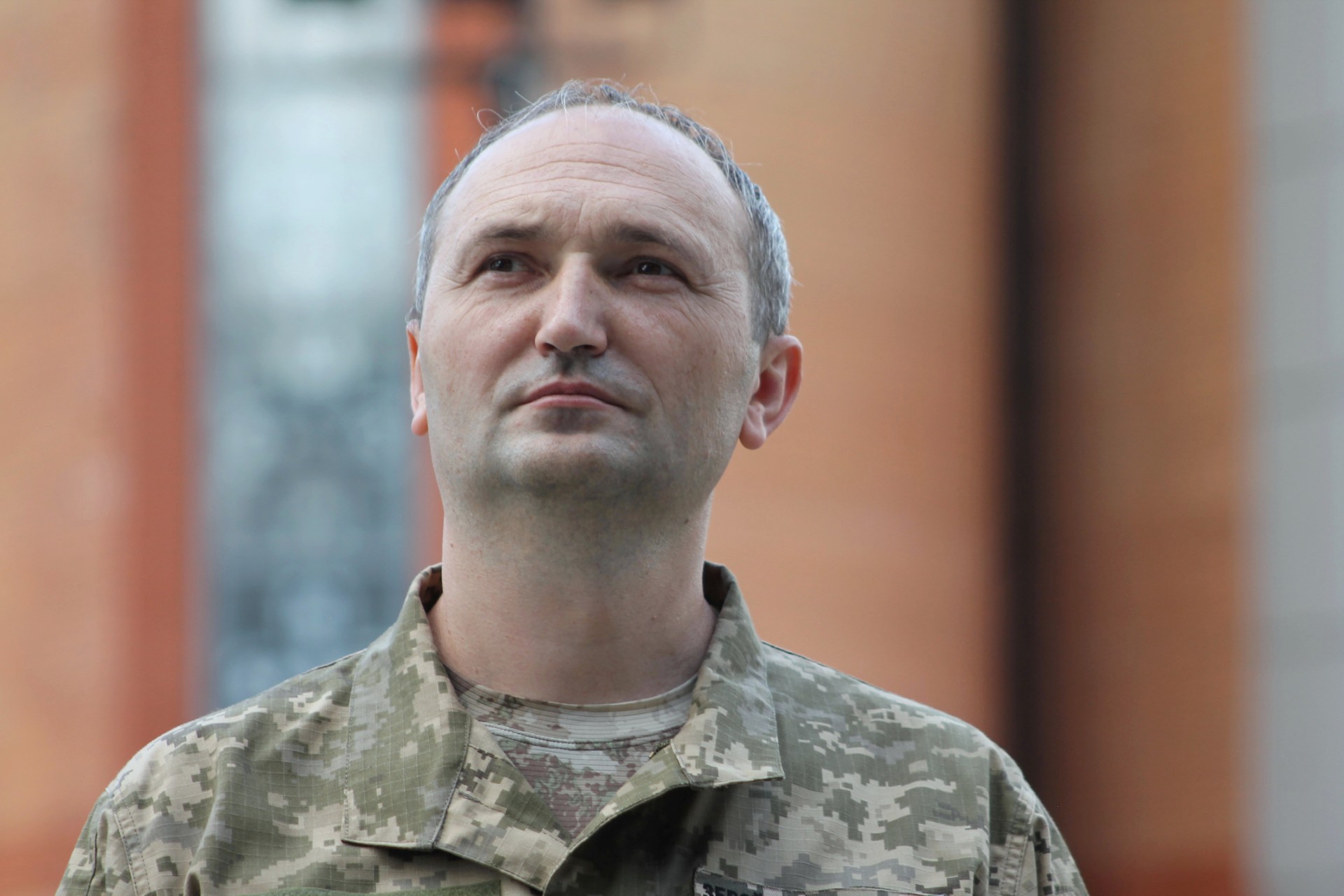
A few days before the latest wave of attacks, a Ukrainian Air Force officer sits in a café near Kyiv’s central railway station, sipping his morning coffee. Artem—an alias—is a lean man with graying hair and an air of quiet confidence. He has served in the Air Force for many years; beyond that, little can be revealed for security reasons. In his role, Artem has been instrumental in developing Ukraine’s nationwide air raid warning system.
“At the beginning, we weren’t thinking about the political significance of the war,” he says. “Our job was simply to protect the people of this country.“
From Artem’s account, Ukraine’s warning system was far from prepared for the kind of war that began with Russia’s full-scale invasion on February 24, 2022. Communication relied largely on telephone calls, while the country’s analogue air raid sirens had to be activated manually. Within four months, he says, the system had been brought to a functional standard. Today, it has been “completely transformed” to meet the demands of modern aerial warfare.
In theory, the principle is straightforward. Once a threat—a missile or a swarm of drones, for example—is identified, an air raid alert is issued for the regions deemed to be at risk. Residents receive the warning through sirens, smartphone apps, or messaging bots, urging them to seek shelter immediately.
In practice, however, the process is far more complicated. Operators must identify a threat as early as possible, giving civilians enough time to reach safety. Out of thousands of potential targets, they have to determine which ones are likely to be struck this time. At the same time, they cannot sound the alarm too often, lest people begin to ignore the warnings. All of this unfolds in an environment of constant technological change, forcing the system to evolve just as rapidly.
Foreign Partners Help Detect Missile Attacks
At the very first stage—identifying an emerging threat—Ukraine still depends in part on assistance from abroad. Russia’s strategic bombers, for example, frequently take off from air bases in places such as the Murmansk region or deep inside Siberia, thousands of kilometers from the Ukrainian border.
“When the threat originates from distant parts of Russia, we receive our information from our strategic partners,” Artem says, declining to elaborate further.
Most likely, he is referring to satellite surveillance and other intelligence assets operated by allied countries—capabilities that allow them to monitor Russian air bases and alert Kyiv the moment a strategic bomber takes off.
Other types of threats, however, are detected by Ukraine itself.
“When the danger originates closer to home, our intelligence services take over and provide us with the necessary information,” Artem explains.
He is referring primarily to long-range kamikaze drones such as the Iranian-designed Shahed and its Russian-produced successor, the Geran.
But how do Ukraine’s operators know where a missile or drone is heading?
“It’s all about experience,” Artem says. “When an experienced operator is on duty and identifies a threat, he can predict the intended target with about 70 percent certainty. Combined with intelligence from our own services and our partners, we can soon determine with complete confidence where that projectile is headed.”
The warning itself reaches Ukrainians through several different channels. There are the air raid sirens, whose haunting wail has become one of the defining sounds of daily life in wartime. Alongside them, a wide range of smartphone apps and Telegram bots display maps of Ukraine with threatened regions highlighted in red. They send push notifications and provide real-time updates—often accompanied by short text messages or graphics—explaining what kind of attack is unfolding and where.
For those who constantly monitor these channels, they offer a reasonably accurate picture of the current level of danger. Many Ukrainians therefore keep a close eye on their phones throughout the day. Others choose to ignore the alerts as much as possible, unwilling to let their lives be dictated by the relentless rhythm of air raid warnings.
Despite their different appearances, all of these apps and warning channels have one thing in common: they rely on data generated by Artem’s system.
Its greatest achievement, he says with pride, has been the dramatic reduction in the time between identifying a threat and issuing a public warning.
In the early months of the war, it took roughly six and a half minutes for an alert to reach people in the affected regions.
“Soon we had cut that down to three or four minutes,” Artem says. “Today, we’re at just 40 seconds.”
That improvement has been made possible by a series of changes: replacing phone calls with digital messaging, improving coordination among the agencies involved, and gradually introducing digital sirens, which—unlike their mechanical predecessors—can sound almost instantly. In cities such as Kyiv, where the new technology has already been deployed, Artem says the delay between detecting a threat and activating the alarm has in some cases been reduced to as little as 20 or even 15 seconds.
For all its progress, the system is far from infallible.
According to Artem, there have been cases in frontline cities where Russian drones struck air raid sirens, attempting to degrade the warning network. That, he says, is one reason why a reliable digital system capable of reaching people directly on their smartphones is so important.
Yet even the digital network cannot provide absolute protection.
Russia has increasingly launched some of its ballistic missiles from positions so close to Ukraine that they reach their targets in as little as two to four minutes. In recent weeks, Kyiv has seen several strikes in which missiles hit before the air raid warning could even be activated.
Incidents like these undermine the fragile sense of security that Ukrainians have painstakingly built over more than four years of war—a sense of normality that makes everyday life, however precarious, still possible.
Despite these vulnerabilities, Ukraine has succeeded in building what is now one of the world’s most sophisticated civilian air raid warning systems. It is not flawless, but it combines countless interlocking components to create an extraordinarily effective network—one that enables the country, in many cases, to determine what is coming from the sky, when it will arrive, and where it can ideally be intercepted before reaching its target.
In doing so, it deprives Russia of one of its most powerful weapons: the constant fear that death might descend from a clear blue sky at any moment.
For Artem, however, today’s challenges are only part of the job. He also has to think about tomorrow.
“Some of the functions built into our system aren’t even being used yet,” he says. “We had to prepare for every conceivable scenario—including nuclear attacks.”
Artificial intelligence, however, has so far played no role in the warning system itself.
AI is becoming increasingly important elsewhere in the war. Some Russian drones, for example, are now capable of navigating to their targets autonomously. But Artem still prefers to rely on human judgment.
“We have our own intelligence,” he says with a wry smile. “Maybe we’ll use artificial intelligence in the future.”
Another major challenge for the future, Artem says, is international cooperation.
“If necessary, our system could be adapted to serve not only Ukraine, but all of Europe,” he says. But he is quick to add an important caveat.
“God forbid Germany is ever attacked. Even then, it wouldn’t be able to copy our system one-to-one. Building something like this takes enormous experience—and time. It’s not easy.”
Journalist Hauke Friederichs, who co-authored the book If War Came Tomorrow (Wenn morgen bei uns Krieg wäre) with Rüdiger Barth, recently argued in an interview with WELT that Germany still has “an enormous amount of work to do”when it comes to protecting its civilian population.
The country, he said, lacks enough air defense systems to shield residential areas on a broad scale. There are far too few shelters, and even air raid sirens remain in short supply.
The German government plans to invest €10 billion in civil protection by 2029. The money is intended to strengthen public preparedness through a package of measures that includes modernizing warning systems, providing citizens with more comprehensive information on how to respond in times of crisis and improving coordination among the authorities.
For Artem, that last point is perhaps the most important.
“We realized very early on that all of our institutions and resources had to work together if this was going to succeed,” he says. “To build a system like this, you have to understand the mentality of your own people. We understand ours. But Germany would need a different approach. Before we can help, we’d first have to understand how your system works today.”
So, before Ukraine can share the lessons it has learned under fire, Germany still has considerable work to do itself.
Read the original article on Die Welt – Ukraine-Krieg: „Heute stehen wir bei 40 Sekunden“ – Wie Artems System Menschenleben rettet – WELT
