
By Trident Group Ukraine LLC (TGU)
Over the past four years, Ukraine has transformed itself from a major consumer of defense equipment into one of the world’s most dynamic defense technology ecosystems. What began as an urgent wartime response has evolved into a rapidly expanding industrial sector capable of designing, testing, manufacturing, and improving military systems at remarkable speed.
New research prepared by CASE Ukraine, with expert contributions from Ihor Fedirko, Anastasiia Mishkina, Lobby X, and representatives of Ukraine’s defense technology sector, argues that the industry’s biggest challenge is no longer innovation. Instead, the future of Ukraine’s defense-industrial base will increasingly depend on procurement policy, regulation, financing, workforce development, and export policy.
The central conclusion is straightforward: Ukraine’s defense industry has demonstrated that it can innovate and manufacture at scale. The question now is whether state institutions can create the conditions necessary for sustained growth.
From Defense Industry to Defense Ecosystem
Before Russia’s full-scale invasion, Ukraine maintained a substantial defense-industrial base, though much of the sector remained fragmented and underinvested.
Today, Ukraine’s defense ecosystem includes approximately 1,100 defense companies, more than 2,300 startups and R&D teams, and around 400,000 people working across the broader sector. Annual manufacturing capacity is estimated at approximately USD 55 billion.
Yet a significant gap remains between potential and actual output. Many manufacturers continue to operate below capacity because available procurement funding does not fully utilize existing production capabilities. In practical terms, factories capable of producing substantially more equipment often lack the long-term orders needed to justify further expansion. At the same time, domestic manufacturers are playing an increasingly important role in meeting Ukraine’s defense requirements. According to the research, the share of Ukrainian producers in lethal-category procurement increased from 46% to 82% in 2025, while imports declined from 54% to 18%.
This shift strengthens Ukraine’s resilience, reduces dependence on foreign supply chains, and allows battlefield lessons to be incorporated directly into product development.
Drones: The Fastest-Growing Segment
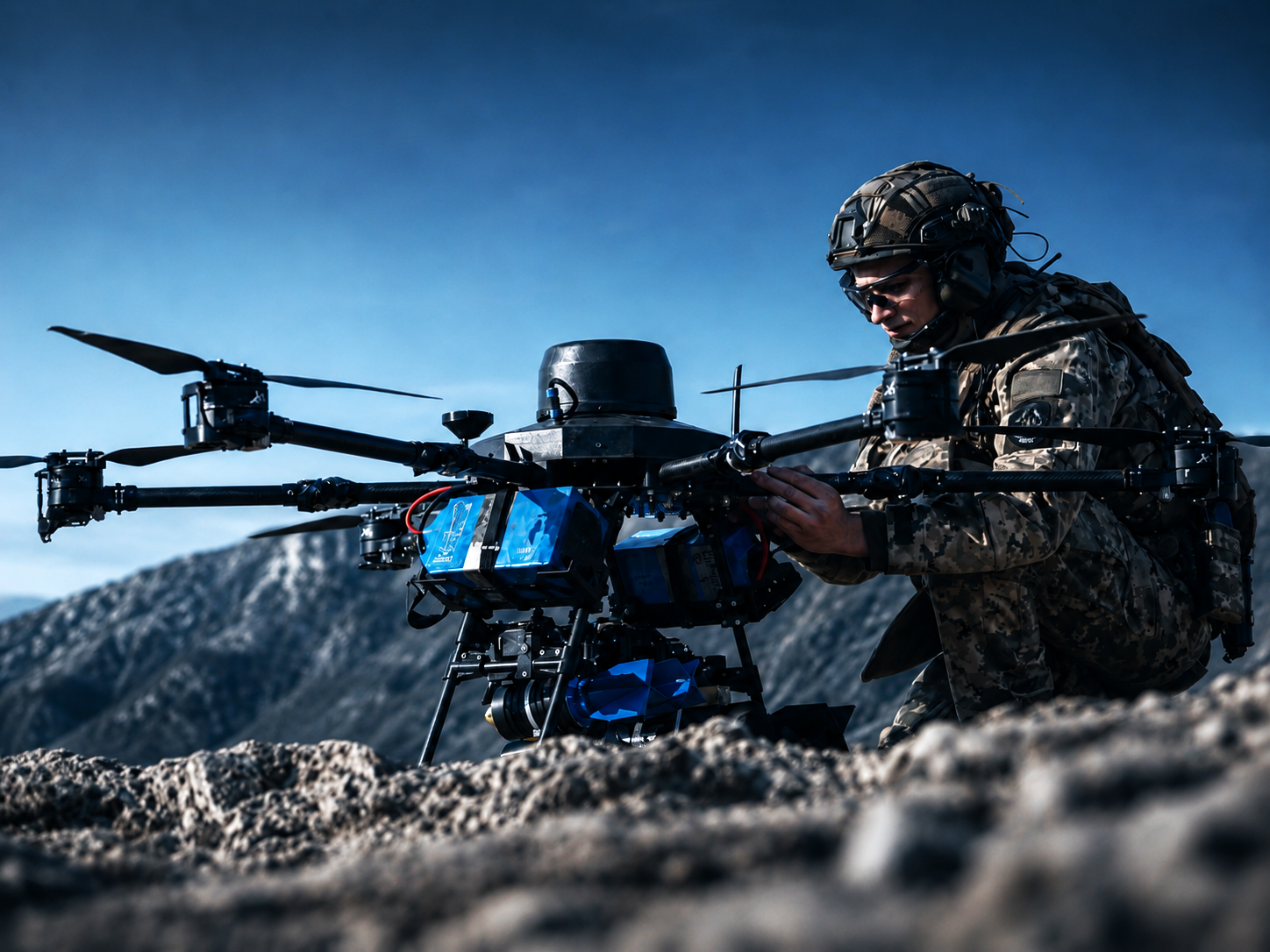
No area better illustrates Ukraine’s defense-industrial transformation than the unmanned systems sector.
The research estimates that Ukraine produced approximately 4 million drones in 2025 and aims to exceed 7 million units in 2026. Much of this growth has been driven by private companies rather than traditional state-owned enterprises. Ukrainian manufacturers have become key innovators across FPV strike drones, interceptor drones, reconnaissance platforms, electronic warfare systems, ground robotic systems, and autonomous technologies.
Equally important are the procurement mechanisms supporting this growth. Platforms such as Brave1 Market, DOT Chain Defence, and the “ePoints” system help connect battlefield demand directly with manufacturers, shortening procurement cycles and accelerating the delivery of new capabilities to frontline units.
This continuous feedback loop between operators and producers has become one of Ukraine’s greatest competitive advantages. Systems can be refined and improved within weeks rather than years.
The emergence of interceptor drones is a particularly notable example. As Russia continues to employ large numbers of Shahed-type attack drones, Ukrainian developers have created lower-cost interception solutions that reduce reliance on expensive missile-based air defense systems.
The broader lesson extends beyond drones. Ukraine has demonstrated how speed, adaptability, and continuous iteration can become strategic advantages in modern warfare.
International Partnerships and Industrial Integration
Ukraine’s defense industry is becoming increasingly integrated into the global defense market through partnerships with international companies such as Rheinmetall, Thales, Kongsberg, and others.
These relationships provide more than immediate production benefits. They support technology transfer, joint development, manufacturing expansion, interoperability with NATO standards, and integration into global defense supply chains.
For international companies, Ukraine offers access to one of the world’s most active defense innovation environments. For Ukrainian manufacturers, these partnerships create opportunities to attract investment, access advanced technologies, and expand into international markets.
However, the research notes that growth is still constrained by several structural bottlenecks. Procurement processes often remain slower than the pace of battlefield innovation. Long-term planning mechanisms remain limited. Technical standards are not always harmonized. Manufacturers continue to face shortages of skilled labor, dependence on imported electronics and components, and restrictions on export opportunities.
Addressing these issues will be essential if Ukraine is to convert wartime innovation into long-term industrial competitiveness.
The Real Challenge Is No Longer Technology
The most striking conclusion of the research is that Ukraine’s primary challenge is no longer technological capability. The country has demonstrated an ability to innovate, manufacture, and adapt under some of the most demanding conditions imaginable. The challenge now lies in creating a supportive institutional environment that allows successful companies to scale.
Manufacturers need predictable procurement, clearer regulatory frameworks, access to financing, skilled workers, and practical export mechanisms. Without these conditions, even highly innovative companies may struggle to reach their full potential.
Ukraine is entering a new phase of defense-industrial development. The first phase was defined by survival and rapid wartime innovation. The next phase will be defined by sustainability, scale, and international competitiveness.
If Ukraine can align procurement, regulation, financing, and export policy with the capabilities already demonstrated by its private sector, it has the potential to become one of Europe’s most important defense manufacturing hubs.
The technology exists. The talent exists. The production capacity increasingly exists. The decisive question is whether the state system can evolve quickly enough to match the industry’s pace.
Watch the video to learn more about the issue and the context behind it.
