
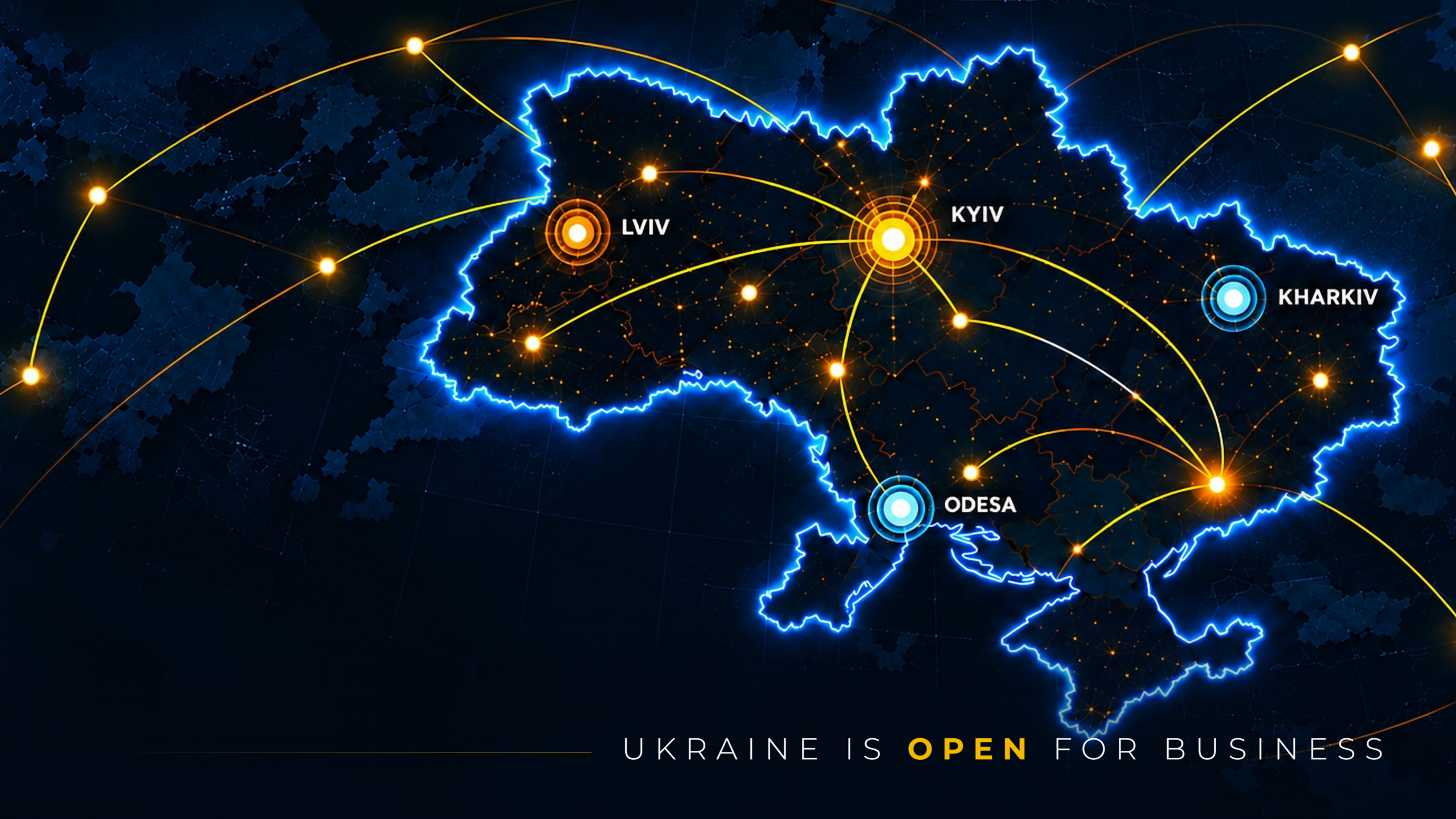

Ukraine Is Open for Business.Are You Planning for the Right Risks?
Nick Iltsopoulos
Chief Executive Officer, Trident Group Ukraine LLC
For most American companies, the biggest risk isn’t a missile. It’s making decisions based on a picture of Ukraine that doesn’t match reality.
Security and operational risks for U.S. companies
01 — The starting point
The biggest risk isn’t a missile.
American executives considering Ukraine tend to ask me the same three questions. My answer starts with a point that often surprises them: for most American companies, the biggest risk is making decisions based on a picture of Ukraine that doesn’t match reality.
What are the biggest security and operational risks?
Which of them can realistically be managed?
What should be in place before committing people or assets?
Two ways to get it wrong
Too cautious
Staying away from opportunities that could be managed safely.
Wrong threat model
Going in with plans built for the wrong threat.
Both start from the same error: a picture of Ukraine that doesn’t match conditions on the ground.
The five categories of risk
01
Kinetic
02
Infrastructure
03
People and contractors
04
Insider and cyber
05
Counterparty, legal, financial
Kinetic risk depends on where you are, and now on when.
Missiles, drones and glide bombs are the risk everyone thinks of first. How much they matter depends heavily on location, and a company that treats Ukraine as a single risk will get it wrong.
Four cities, four very different risk environments. Plan for the location, not the country.
The picture has changed
Attacks are no longer confined to the night.
Before
Mostly at night and early morning. Most incoming threats intercepted. Kyiv was relatively manageable.
Now
Attacks at any time of day.
Disruption is routine. Plan for it.
Power outages, connectivity problems and logistics disruptions happen regularly, especially after attacks on the grid. Any operating plan has to assume them.
Your staff live with this every day.
Workforce. Mobilization affects the male workforce, and fatigue and stress are real. Plan for deferment of critical staff where they are eligible.
Movement. There are no commercial flights, so getting people in and out of the country has to be planned in advance.
Labor shortages are now the top barrier for Ukrainian industrial companies. Mobilization is the main driver.
Source: Institute for Economic Research and Policy Consulting, monthly enterprise survey
Contractor delivery
Most work on the ground runs through Ukrainian contractors and subcontractors. Any of these can stop a crew mid-project:
An attack
Road closures
Curfew
Key specialists mobilized
Your own people and systems are part of the threat surface.
Russian services recruit people online to carry out attacks inside Ukraine. They also target employees, contractors and company networks for information.
Online recruitment for attacks
Targeting for information
Know who you’re really dealing with.
Who are you really doing business with?
Who are the beneficial owners?
Is there a Russian connection you haven’t found?
The financial layer
Repatriation
Currency controls under martial law still limit how and when profits can be repatriated.
Banking
Some foreign banks are reluctant to handle Ukraine-bound transactions.
02 — What can be managed
Almost all of it.
Most of these risks respond to the same disciplines companies already apply elsewhere.
| Risk | How it is managed | Outlook |
|---|---|---|
| Infrastructure disruption | Generators, satellite connectivity and redundancy | ✓ Manageable |
| Counterparty | Real due diligence | ✓ Manageable |
| Personnel | A proper duty-of-care program | ✓ Manageable |
| Contractor | Schedule buffers and supplier redundancy | ✓ Manageable |
| Insider | Vetting | ✓ Manageable |
| Currency | The right deal structure | ✓ Manageable |
| Kinetic | Can’t be eliminated. Layered protection, below. | ↓ Reducible |
Kinetic risk
It can’t be eliminated. It can be reduced significantly.
Each layer makes a measurable difference: where you locate, where you house people, shelter access, alerting and disciplined procedures.
03 — Before you commit people or assets
Five things to have in place first.
A location-specific threat and vulnerability assessment
Current, and built on conditions where you will actually operate, not on national headlines.
A security and crisis plan with evacuation triggers
Decide in advance who makes the call, and at what point.
A trusted security provider on the ground
Someone monitoring threats around the clock and providing duty of care, including secure transportation and emergency evacuation.
Redundancy, plus a cybersecurity baseline from day one
Power, communications and data. Apply the same logic to people: backup contractors and crews, schedule buffers in your contracts, no single points of failure in key personnel.
The right insurance and the right deal structure
Coverage for your people and your assets, detailed below.
Insurance · Personnel
Several companies have told us their insurer would not cover travel to Ukraine. That doesn’t have to end the conversation: specialist providers offer supplemental coverage, and we can help you meet the requirement.
Insurance · Assets
War-risk and political violence coverage is available through:
MIGA (World Bank Group)
Western export credit agencies
Export Credit Agency of Ukraine
Read the exclusions carefully, and structure the deal around currency controls from day one.
04 — Not ready to send people?
You don’t have to sit out.
Our team, with USAID backgrounds, provides strategic advisory and support services on the ground. You can build your position in this market before you put a single person at risk.
92%
of AmCham member companies are fully operational
AmCham Ukraine with Citi Ukraine, member survey, June 2026
87%
plan to keep or increase their investment this year
AmCham Ukraine with Citi Ukraine, member survey, June 2026
90%
of foreign companies have no plans to relocate
Sayenko Kharenko and SK Security, business security assessment
70%
now have dedicated security departments
Sayenko Kharenko and SK Security, business security assessment
